


Recently, Yao Liu (PhD student in Public Health), Hankai Zhang (Undergraduate student in Food and Nutritional Science), and Zhou Zhang (Master’s student in Public Health) from the Faculty of Medicine at the Macau University of Science and Technology (MUST) served as co-first authors on a review paper published in Trends in Food Science & Technology. This journal is a top-tier publication in the field, with an Impact Factor of 15.4 and a ranking of 2/182 in the Food Science & Technology category by Clarivate Analytics.
The paper is titled “Food contact materials based on N-halamines or photosensitizers: An emerging strategy for developing ‘rechargeable’ antibacterial properties”. The Faculty of Medicine at MUST is the first affiliation for this paper, and Associate Professor Tian Zhong served as the corresponding author. This research was funded by the Macao Science and Technology Development Fund (Grant Nos. 0005/2024/AGJ and 0009/2023/AFJ).
Research Summary
Over the past few decades, researchers have developed various biodegradable and renewable antibacterial materials for food packaging. While these materials can be reprocessed into new forms after their service life, the regeneration of these materials involves complex procedures, relies on specialized industrial facilities, and makes it difficult to effectively maintain their original antibacterial performance. Recently, an innovative strategy for recycling food contact materials was proposed. Inspired by rechargeable batteries, this method allows the material to be repeatedly replenished to restore its antibacterial performance through a simple “charging” process without changing its physical form. This review defines “rechargeable” as regenerating antibacterial activity through chemical treatment (e.g., NaClO immersion) or energy input (e.g., light exposure). Combining experimental data with application cases, the paper systematically summarizes the material forms, charging efficiency, cyclic antibacterial performance, and safety evaluation of these materials. This “rechargeable” strategy has the potential to facilitate the transition of food contact materials from the “single-use” model to a sustainable “recycling” model.
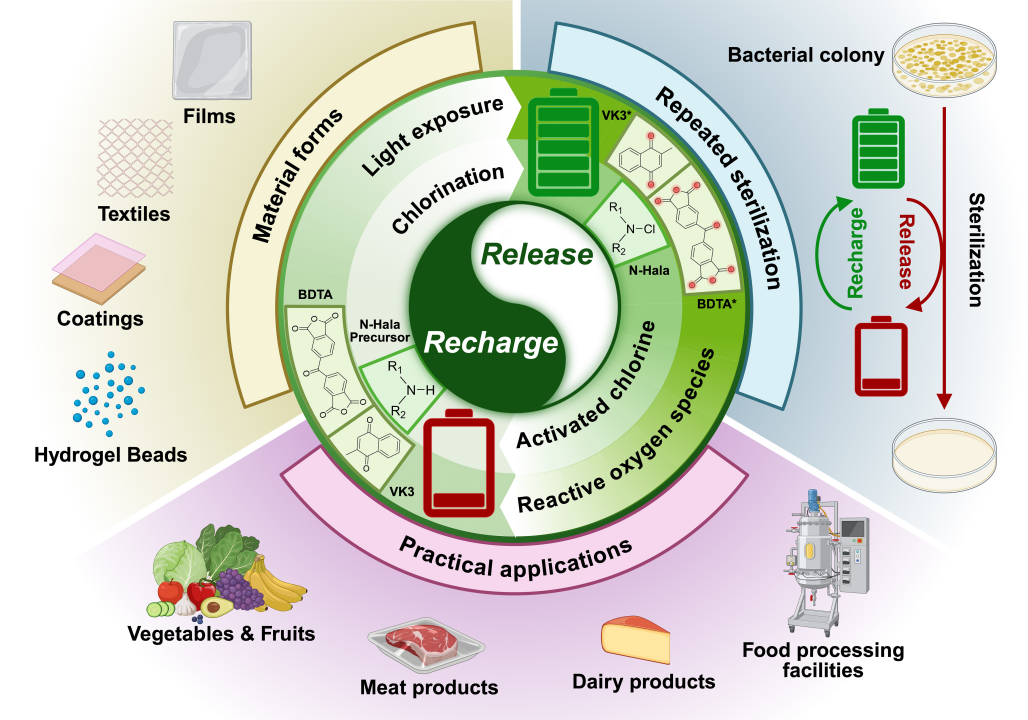
Forms mechanisms, and applications of food contact materials with rechargeable antibacterial properties.
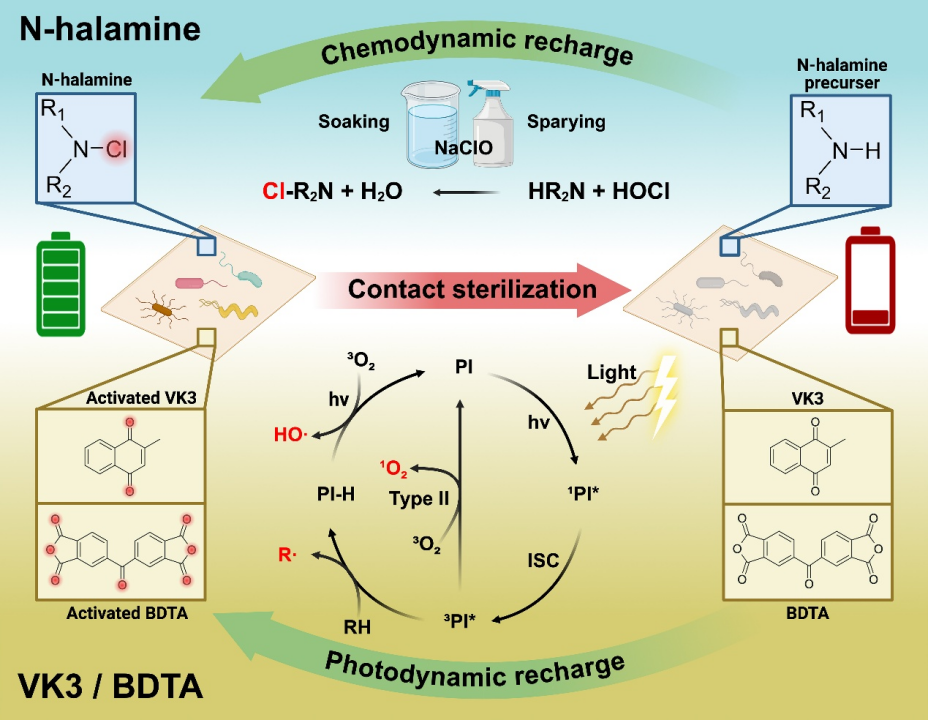
Schematic diagram of the "charge-discharge" cycle for the antibacterial activity of N-halamines and photosensitizers.
Article Link: https://doi.org/10.1016/j.tifs.2025.1052

Group Photo: (From left) Yao Liu, Hankai Zhang, and Zhou Zhang.

