


A research team led by Associate Professor Tian Zhong at the Faculty of Medicine, Macau University of Science and Technology (MUST), has developed smart active packaging that adjusts its antibacterial and antioxidant functions as the storage environment changes. Published on 9 September 2026 in Advanced Functional Materials (impact factor 19.9; Q1), the study is titled “Smart Active Packaging with Full-Cycle Adaptability: Light-Enhanced, pH-Switchable Nanozyme Films for Fresh-Cut Salmon Preservation.” Made using discarded yuzu peel, the film extended the shelf life of fresh-cut salmon by at least four days in refrigerated storage trials.
Research published in Advanced Functional Materials.
Salmon is rich in high-quality protein and polyunsaturated fatty acids, but fresh-cut fillets are vulnerable to microbial contamination and lipid oxidation, which affect their colour, texture and quality. Preservation is complicated by changes in the local environment during storage. The accumulation of metabolic products initially increases acidity; later, protein breakdown and the build-up of volatile nitrogen compounds cause the pH to rise. Developing packaging that responds to these changes could help protect the fish at different stages of storage.
To address this challenge, the team converted yuzu peel into carbon dots and introduced copper ions to produce copper-coordinated carbon dots that respond to changes in pH. These nanomaterials, known as nanozymes, mimic some of the catalytic functions of natural enzymes. The researchers incorporated them into a composite matrix of sodium alginate, konjac glucomannan and polyvinyl alcohol, producing an active film with antibacterial, antioxidant and barrier properties. The approach also offers a way to turn discarded fruit peel into a functional packaging material.
The film adapts its activity to the surrounding pH. Under acidic conditions in early storage, the copper-coordinated carbon dots exhibit peroxidase-like activity, catalysing hydrogen peroxide to generate hydroxyl radicals that damage bacterial cell membranes. As the environment approaches neutrality, functional groups on the carbon dots help scavenge free radicals and slow lipid oxidation. Brief near-infrared irradiation further enhances the material’s photothermal and catalytic activity, allowing its preservation functions to respond to changes in the salmon’s local environment.
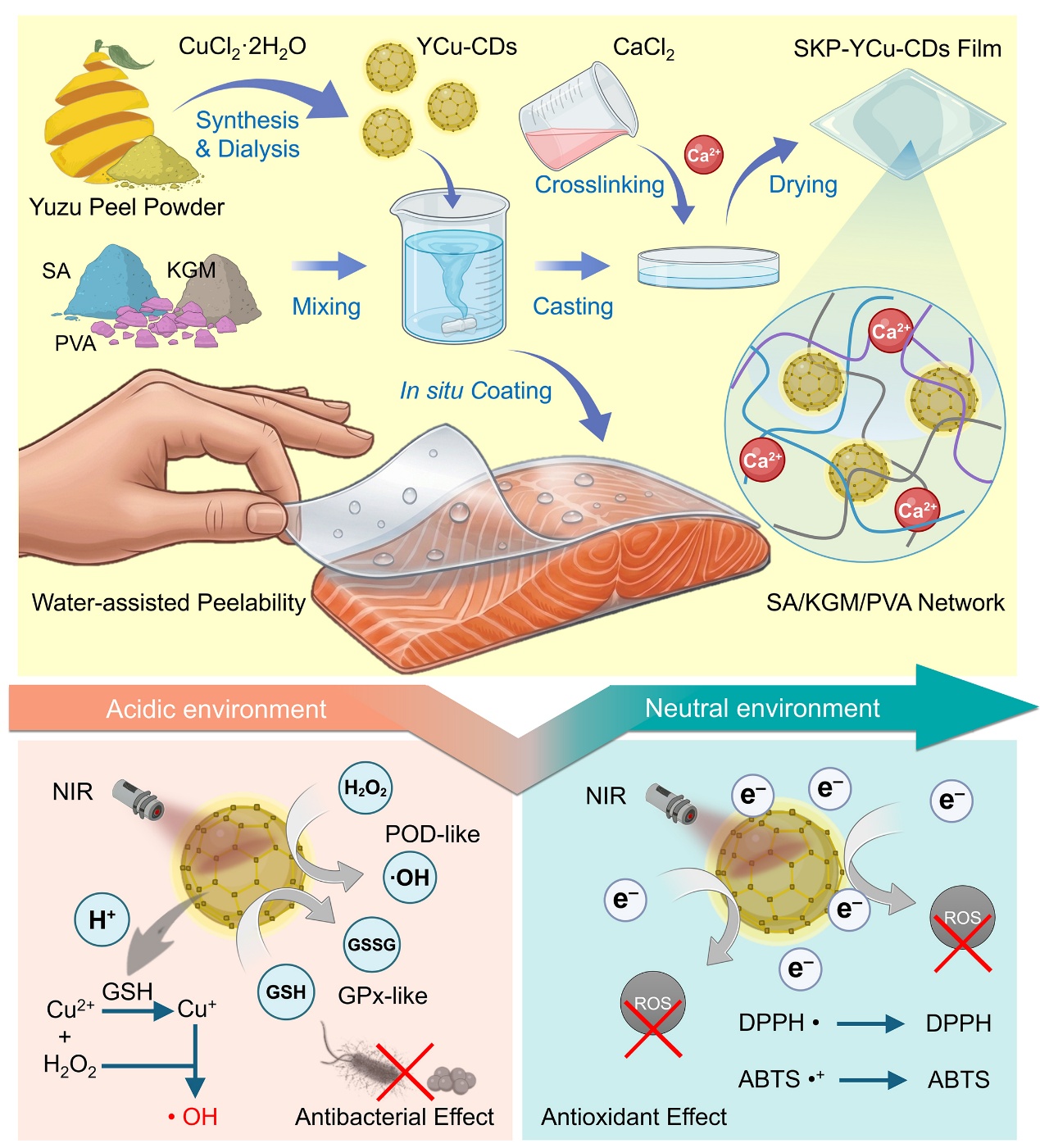
Preparation of the smart active packaging film, its water-assisted peelability, and its pH-responsive antibacterial and antioxidant mechanisms.
The study also examined the film’s practical performance. Incorporating the carbon dots provided effective barriers against ultraviolet light and water vapour, while the film retained high ductility when wet, with elongation at break exceeding 300%. The researchers used this property to design a water-assisted peelable interface. The film adheres to the fillet during storage and can be removed intact after contact with water, combining preservation with convenient removal.
In salmon preservation trials at 4 °C, the researchers applied one minute of near-infrared irradiation every 48 hours. The combined treatment suppressed microbial growth and delayed the accumulation of total volatile basic nitrogen and lipid oxidation products. After ten days, the peroxide value in the treated group was more than 75% lower than in the control group. The treatment also helped maintain the fish’s firmness, springiness and muscle fibre structure. Taken together, the results showed a shelf-life extension of at least four days under the tested conditions.
By combining the use of agricultural by-products with nanozyme catalysis and active food packaging, the study offers a material design approach that responds to changes in food during storage. Its biodegradability and water-assisted peelability provide further directions for developing sustainable packaging for high-value aquatic products. The work also reflects the Faculty of Medicine’s research across food science and functional materials.
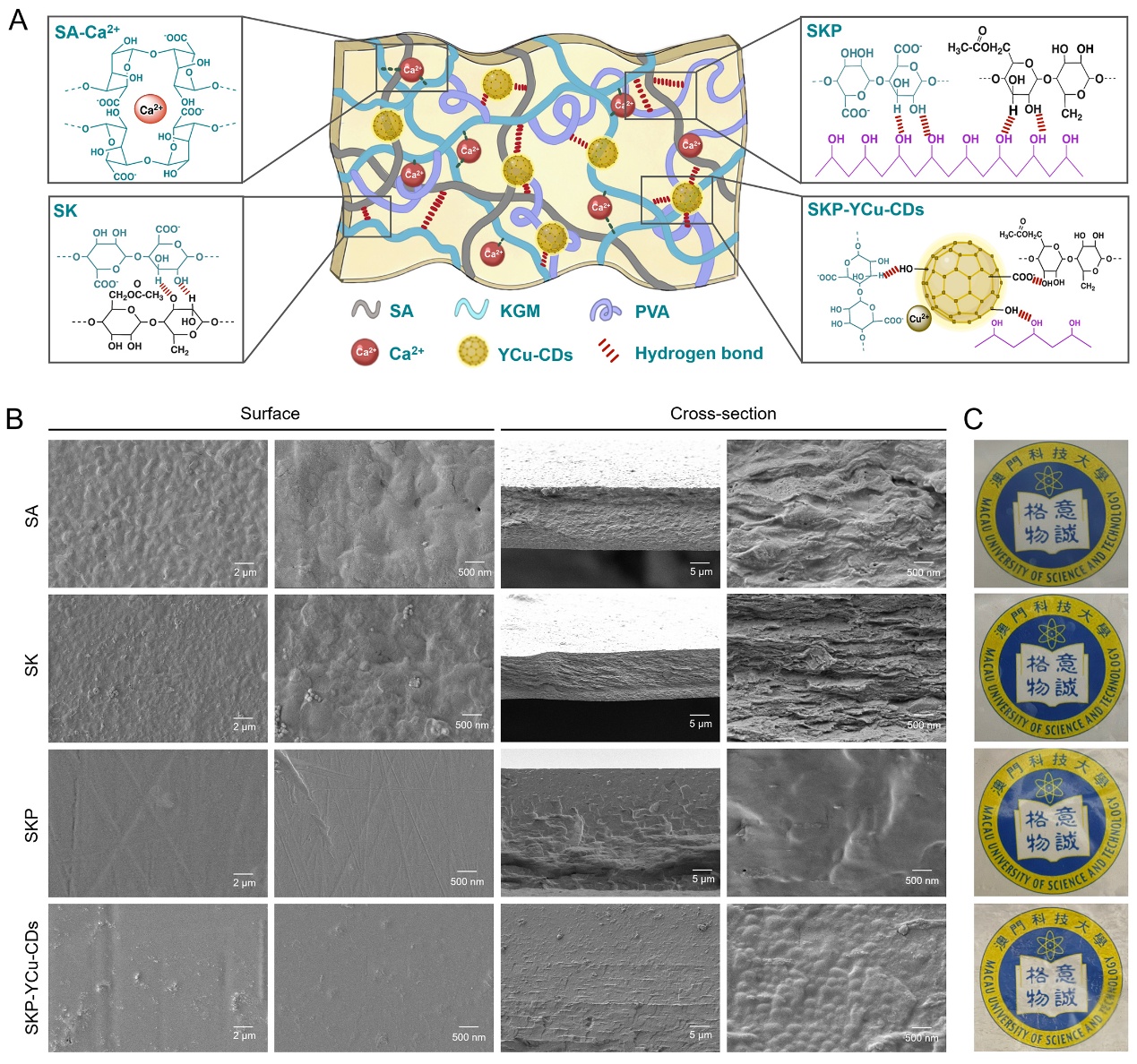
Schematic model of the microstructure, scanning electron microscopy (SEM) images, and digital photographs of the composite film.
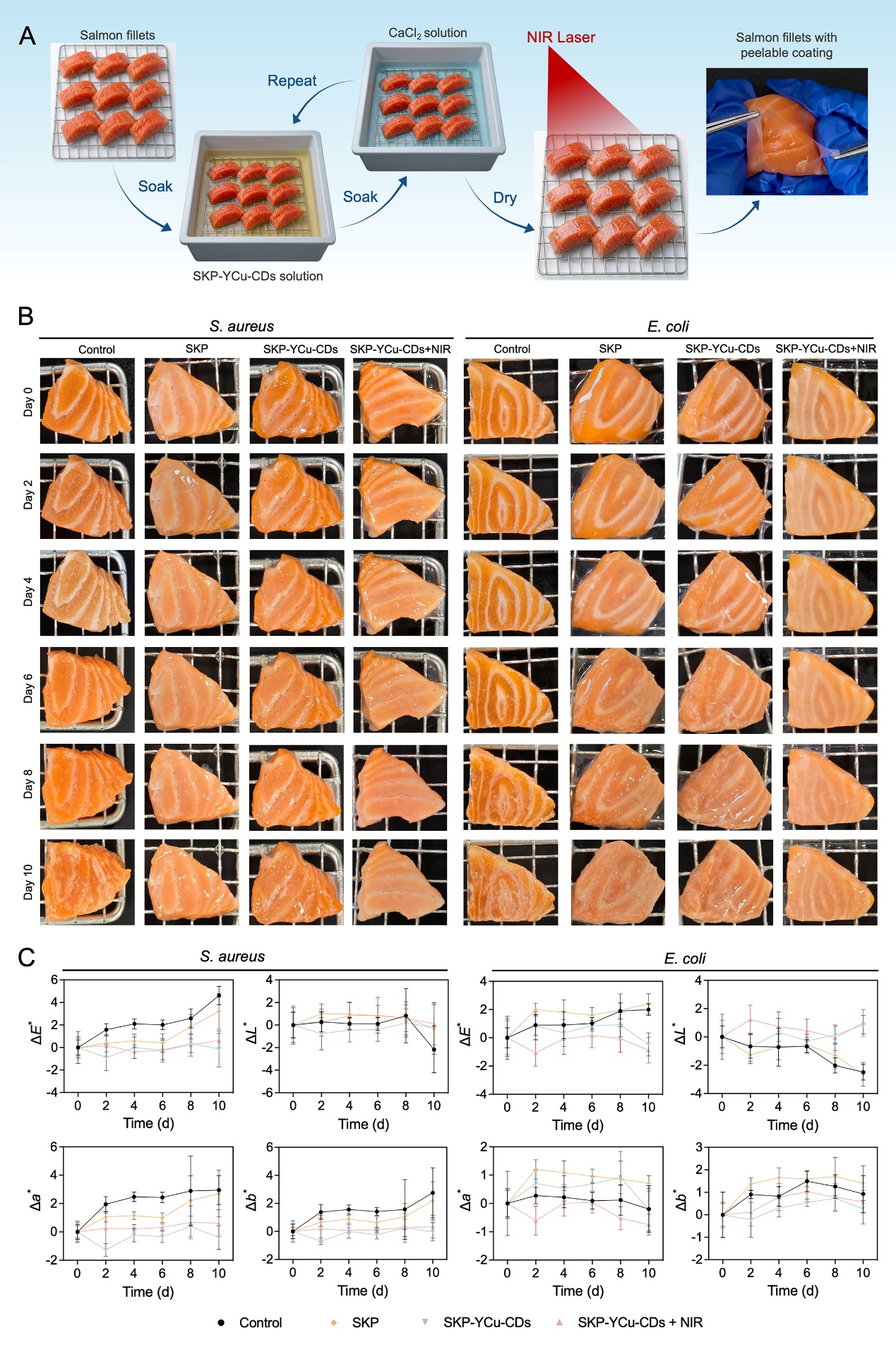
Salmon coating and near-infrared treatment procedures, with changes in appearance and colour across treatment groups during refrigerated storage.
The Faculty of Medicine at MUST is the first-listed affiliation. Yuhe Dong, Tong Wu and Xiaohui Jia are co-first authors, and Associate Professor Tian Zhong is the corresponding author. The research was supported by the Science and Technology Development Fund, Macao SAR (FDCT), under projects 0005/2024/AGJ and 0009/2023/AFJ.
Article link: https://doi.org/10.1002/adfm.78291

